
With AI tools writing full functions in seconds and no-code platforms letting you drag-and-drop your way to a website, people are asking: Is coding still relevant in 2025?
I have been thinking about this a lot, not just as a Computer Science student, but also as someone who has been watching trends online. In this post, I will break down this fear of replacement, what is changing in the coding world, and why I still believe learning to code is one of the smartest moves you can make.
Enjoy, and let’s dive in!
Where does this fear come from?
The “programmers are cooked” narrative is not new. Every relevant shift in technology (calculators replacing mental math, to automated factories taking over assembly lines, to the internet reshaping entire industries) has come with the same question: Will humans still be needed? Is coding still relevant?
Spoiler: yes, every single time.
AI is the newest, shiniest thing out right now, and there is a lot of excitement about it. Naturally, people jump to the assumption that it is going to take everything over (including programming). The news cycle does not help. Headlines love predicting the end of jobs, the collapse of industries, or the death of certain skills. Influencers are constantly promoting no-code and low-code platforms as “the end of programming,” making it seem like typing out actual code is becoming irrelevant.
But if you zoom out, most of this panic comes from a misunderstanding of how technology works in the real world. Tools do not operate in a vacuum; they require human direction, context, and creativity. Just like calculators did not replace mathematicians, AI will not replace the need for people who understand, design, and guide the systems that power our digital world.
Change is Good
Here is the truth: AI can generate code. Sometimes it is great. Sometimes it is… creative in ways you did not ask for. But even when AI gets it right, someone still has to:
- Define the problem clearly.
- Check if the solution is correct, secure, and efficient.
- Adapt it to fit the real world.
Coding today is not about sitting in a dark room typing every semicolon by hand. It is about understanding how systems fit together, identifying the right approach, and making sure the end product works for people, not just for the machine.
AI can be a great partner, but it does not replace the need for human insight. Think of it like working with an assistant who can write quickly but does not always understand the context. Without your guidance, the results can be flawed, incomplete, or even harmful in the long run.
If you understand how things work under the hood, you are in control, whether you are building from scratch or using AI to build faster. The role of a coder is evolving, but that is not a bad thing. Change keeps the skill relevant, challenging, and more exciting than ever.
But, tech is oversaturated, right?
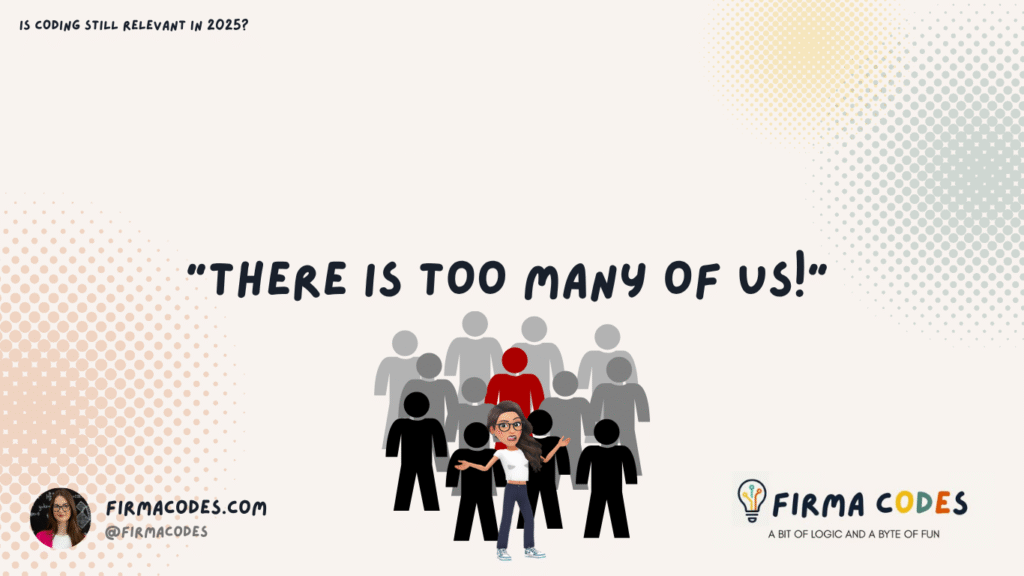
Yes, there are more developers now than there were ten years ago. But that does not mean the field is “full.”
What it means is that the industry is growing. Coding is not just for a handful of specialists anymore; it is becoming a core skill across an endless number of industries. The demand for software is not shrinking; it is expanding into medicine, education, finance, art, and practically every other field you can think of.
AI-generated code and no-code platforms are fantastic for quick prototypes or small-scale apps. They make it easier for people to experiment and bring ideas to life faster. But when it comes to large, complex systems, building truly custom solutions, or working with sensitive data that cannot afford mistakes… humans still run the show.
The real difference between using a tool and understanding it is like the difference between heating a frozen meal and knowing how to cook. Both get the job done, but only one gives you the ability to adjust the recipe, add your unique flavor, and create something entirely new. In tech, understanding gives you control, and control will always be in demand.
My Take
To me, coding in 2025 feels like investing in a superpower. And like any good superpower, it is not about brute-forcing your way through everything, but about knowing when and how to use it. AI and no-code tools are not the enemy; they are part of the toolkit. The key is making sure you are the one in charge, not boxed in by their limitations.
I am not learning to code because I am passionate about typing out every single line manually for the next 30 years. That is not realistic, and honestly, it is not the point. I am learning because with coding, I want to build and create. Coding is a foundation, a way of thinking.
The tech world moves fast, and it is unpredictable. New frameworks, languages, and platforms will keep popping up. But if you know the fundamentals, you can adapt to all of it. You can take advantage of the tools that make life easier without losing your ability to create something original when the situation calls for it.
For me, that is the real investment: not just learning a skill, but building a kind of creative and technical independence that no trend can take away.
Conclusion
So… is coding still relevant in 2025? Absolutely. Maybe more than ever. The tools are changing, but the skill of understanding how to build, adapt, and problem-solve is not going anywhere.
If anything, AI is making coding more powerful, not replacing it. The real winners will be the ones who know how to combine human creativity with machine efficiency.
So keep learning, keep experimenting, and do not let the headlines scare you. Coding is not dead. It is growing, and that is the best part.
Resources
If you enjoyed this post and want to follow my coding journey, tips, and projects, be sure to connect with me! 🤩👋🏼
- Check out my latest projects and code on GitHub.
- Follow me on Instagram and Linkedin for quick tips, behind-the-scenes, and tech life updates.
- Interested in working together or seeing my full experience? Take a look at my Portfolio.
I would love to hear your thoughts on coding in 2025, feel free to reach out anytime!